
Atopic Dermatitis Drugs Market Set to Reach USD 33.42 Billion by 2035, at a CAGR of 7.70% – SNS Insider


U.S. Atopic Dermatitis Drugs Market to Reach USD 8.62 Billion and Europe USD 7.87 Billion by 2035 as Biologic Therapy Expansion, JAK Inhibitor Adoption, and Novel Remission-Inducing Treatments Drive Demand.
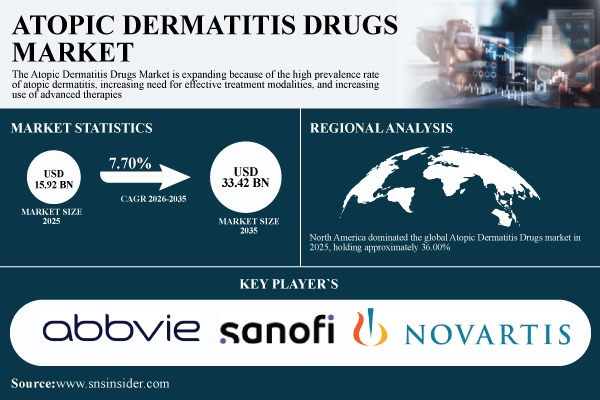
Austin, United States, Sept. 04, 2026 (GLOBE NEWSWIRE) — According to SNS Insider, the Atopic Dermatitis Drugs Market was valued at USD 15.92 Billion in 2025 and is expected to reach USD 33.42 Billion by 2035, growing at a CAGR of 7.70% from 2026 to 2035. The need for these products is growing due to the widespread prevalence of atopic dermatitis and the increased use of more effective advanced products, such as biologics, JAK inhibitors, and PDE4 inhibitors. Atopic dermatitis, which is the most common chronic inflammatory skin disease, is estimated to affect about 200 million individuals, including 20 percent of children and 10% of adults.
Biologic drugs and targeted medicines, new immunomodulators and JAK inhibitors, and developments in the field of drug delivery technologies and combined therapy approaches have become an important factor in modernizing the treatment of atopic dermatitis.
Download the Atopic Dermatitis Drugs Market Sample Report: https://www.snsinsider.com/sample-request/6906
Atopic Dermatitis Drugs Market Key Highlights
- Market size, 2025: USD 15.92 Billion
- Market size, 2026E: USD 17.15 Billion
- Market forecast, 2035: USD 33.42 Billion
- CAGR: 7.70% from 2026 to 2035
- Largest region: North America, approximately 36.00% share in 2025
- Fastest-growing region: Asia Pacific
- Largest class: Biologics, approximately 42% share in 2025
- Fastest-growing class: PDE4 Inhibitors
- Largest route of administration: Topical, approximately 55% share in 2025
- Fastest-growing route of administration: Oral
- Largest end use: Retail Pharmacies, approximately 48% share in 2025
- Fastest-growing end use: Hospital Pharmacies
Market Relevance
Atopic Dermatitis management has emerged as a very essential aspect of modern-day dermatological practices considering that at least 200 million individuals across the globe suffer from this condition, with at least 20% of children and 10% of adults being affected by it. Approximately 30 million patients of moderate to severe atopic dermatitis are estimated to need systemically administered treatment, many of whom go undertreated as a result of lack of access to specialist dermatology consultations.
Atopic Dermatitis Drugs Market Overview
These include biologics, JAK inhibitors, and PDE4 inhibitors that are applied topically and orally, through retail and hospital pharmacies. Biologics work on specific immune responses causing inflammation and play an important role in the treatment of moderate-to-severe conditions, while topicals such as corticosteroids and calcineurin inhibitors are the main mode of therapy for the relief of mild-to-moderate symptoms. Peak year sales of about USD 9 billion of Dupilumab account for just the partial coverage of the target moderate-to-severe population.
Strategic Market Outlook
Areas for expansion can be found through biosimilar competition and advanced remission-inducing drugs. Dupilumab biosimilar development once the patents run out may provide competition that will lower prices and make biologic therapy economically viable. The Phase 3 GRACE trial conducted by Sanofi for its amlitelimab anti-OX40L antibody revealed that 57% of patients stayed in remission from the disease without any treatment 36 weeks after treatment ended, which is indicative of a potential trend towards durable remission without drugs as the new form of treatment.
High biologic prices and class-wide warnings on JAK inhibitors constitute a key challenge. The annual cost of biologic therapy in the U.S. for dupilumab, upadacitinib, or abrocitinib is between USD 30,000 and USD 45,000 per person, excluding rebates, whereas the 2022 FDA warning on JAK inhibitors limited their use in elderly patients with cardiovascular risk factors.
Atopic Dermatitis Drugs Market Regional Analysis
North America was the largest region as it accounted for about 36.00% share of total revenue generated by the market in 2025, with the US contributing about 70.35% to regional revenue at USD 4.03 billion through premium biologic therapy coverage by commercial insurance along with the operations of Regeneron, Sanofi, AbbVie, Pfizer, and Eli Lilly in the region.
The U.S. Atopic Dermatitis Drugs Market was valued at approximately USD 4.03 Billion in 2025 and is expected to reach approximately USD 8.62 Billion by 2035, growing at a CAGR of approximately 7.90%.
The Europe Atopic Dermatitis Drugs Market held a market value of USD 3.82 Billion in 2025 and is projected to touch USD 7.87 Billion in 2035 at a CAGR of 7.50% during 2026-2035. The Europe share held by Germany amounted to around 27.84% in 2025 due to statutory health insurance of approved biologics and JAK inhibitors along with presence of LEO Pharma.
Asia-Pacific is the most rapidly growing region with growth forecasts of 12.10% CAGR in China and 11.80% CAGR in India up until 2035. The contribution of Japan’s revenues from the region reached approximately 28.47% in 2025 due to prevalence of atopic dermatitis at 12 to 13% in Japanese children and approval by Japan Pharmaceutical and Medical Device Agency of dupilumab and JAK inhibitors.
Middle East & Africa: The UAE leads regional revenue at approximately 22.84% of the regional total in 2025.
Latin America: Brazil leads regional revenue at approximately 43.84% of the regional total in 2025.
Buy the Atopic Dermatitis Drugs Market Report with Competitive Analysis and 2035 Forecast: https://www.snsinsider.com/checkout/6906
Atopic Dermatitis Drugs Market Segment Analysis
By Class: In 2025, Biologics held a market share of 42%, due to increased use of targeted medicines for the management of moderate and severe disease conditions. PDE4 Inhibitors hold the leading growth rate in the market, due to increasing demand for non-steroidal medication.
By Route of Administration: The topical drug segment holds nearly 55% of the market share in 2025 due to the direct delivery system and reduced chances of any systemic effect. The oral segment is witnessing rapid growth due to increasing preference for systemic treatments among moderate-to-severe cases.
By End Use: Market Share of Retail Pharmacies was about 48% in 2025 due to ease of accessibility of topical creams, ointments, and prescription drugs. Hospital pharmacies are growing at the fastest rate, fueled by increasing access to biologics and systemic therapy for difficult conditions.
Atopic Dermatitis Drugs Market Key Trends
- Rising prevalence of atopic dermatitis and increasing awareness of chronic skin conditions
- Growing adoption of biologic therapies and targeted treatments for moderate-to-severe patients
- Increasing R&D focused on novel immunomodulators, JAK inhibitors, and personalized treatment approaches
- Expanding healthcare access and dermatology care infrastructure supporting early diagnosis
- Continuous advancements in drug delivery systems and combination therapies
Competitive Landscape
The Atopic Dermatitis Drugs Market includes established biopharmaceutical leaders with portfolios spanning biologics, JAK inhibitors, and topical therapies, with competition centred on efficacy differentiation and durable remission potential.
In 2025, AbbVie reported continued strong upadacitinib (Rinvoq) prescription growth, with head-to-head HEADS UP trial data demonstrating superior EASI-75 response rates versus dupilumab. Sanofi advanced amlitelimab anti-OX40L antibody toward regulatory submission following Phase 3 GRACE trial data showing 57 percent of patients remaining in disease remission 36 weeks after treatment cessation. In 2023, Eli Lilly received FDA approval for lebrikizumab (Ebglyss) for moderate-to-severe atopic dermatitis in adults and adolescents, and Arcutis Biotherapeutics received supplemental FDA approval for roflumilast cream for pediatric plaque psoriasis.
Major key players include
- AbbVie Inc.
- Sanofi
- Regeneron Pharmaceuticals
- Eli Lilly and Company
- Pfizer Inc.
- Bristol Myers Squibb
- Novartis AG
- Johnson & Johnson
- LEO Pharma
- Galderma
- Amgen Inc.
- AstraZeneca
- Incyte Corporation
- Roivant Sciences
- Arcutis Biotherapeutics
- Dermavant Sciences
- UCB S.A.
- Glenmark Pharmaceuticals
- Almirall S.A.
- Maruho Co., Ltd.
Explore the Complete Atopic Dermatitis Drugs Market Report: https://www.snsinsider.com/reports/atopic-dermatitis-drugs-market-6906
CONTACT: About Us:
SNS Insider is one of the leading market research and consulting agencies that dominates the market research industry globally. Our company's aim is to give clients the knowledge they require in order to function in changing circumstances. In order to give you current, accurate market data, consumer insights, and opinions so that you can make decisions with confidence, we employ a variety of techniques, including surveys, video talks, and focus groups around the world.

Contact Us:
Rohan Jadhav - Principal Consultant
Phone: +1-315-961-9094 (US)
Email: info@snsinsider.com
 Disclaimer: The above press release comes to you under an arrangement with GlobeNewswire. TheNewsHeadliner.com takes no editorial responsibility for the same.